Reviews
Wesleyan University
You Just Have to Read This: Books by Alumni, Summer 2026
Virginia Pye ’82 | Marriage and Other Monuments (Koehler Books)
In Marriage and Other Monuments, Virginia Pye turns to Richmond, Virginia, in the tense summer of 2020, when the city’s public upheaval of Confederate monuments unfolded alongside private friction within two families. Against the backdrop of the pandemic and Black Lives Matter protests, Pye explores how history presses itself into the personal and the present—not only in civic spaces, but in marriages, families, and inherited ideas of loyalty and belonging.
The novel explores the dynamic of two estranged sisters whose marriages begin to fracture and their relationship meld while the world around them is being remade. As public symbols fall and old narratives are challenged, the characters confront the monuments they have built in their own lives—to family, race, memory, and self-deception. Intimate and politically resonant, Marriage and Other Monuments examines what it means to live through a moment of reckoning and whether collapse can make room for repair.
Read Her Like an Open Book
Two novels set in the South explore the effect of the past on the present
By Bill Wolfe
I took a break for summer vacation that ended up lasting longer than I expected thanks to a computer crash. Now, a few weeks and a new laptop later, I’m back to writing again.
I’ve read several books in the last month but thought I would review them two at a time rather than in one long piece.
Today I’m reviewing a new book by an author whose previous books I’ve enjoyed and a debut novel by an author from Louisiana.
Marriage and Other Monuments — Virginia Pye (Koehler Books, February 2026)
Like Louise Erdrich’s The Sentence, Virginia Pye’s latest novel, Marriage and Other Monuments, is set during the summer of 2020, with the Covid pandemic and Black Lives Matter protests as the backdrop for the characters’ unsettled lives. Where the former was set in Minneapolis, where the BLM protests began after George Floyd was murdered by the police, Pye’s book is set in Richmond, Virginia, where the protests were focused on the removal of statues of Confederate army officers.
-
The plot follows two sisters as their marriages falter. Melissa is a passionate social justice activist who becomes caught up in the monument removal protests. Her husband, Marshall, who is Black, thinks she has gone overboard and doesn’t fully understand the true nature of things. He is more interested in running his business and letting change take place incrementally. When they married, their differences complemented each other, but over time they have begun to find the other difficult to understand.
Cynthia, a CPA, is married to Bobby, the scion of a wealthy family who has never been able to find his own path to success. His grandfather, part of Richmond’s Old Guard, is furious about the protesters disrupting life in his neighborhood near Monument Drive and frustrated with Bobby’s lack of killer business instinct. Cynthia has lost patience with Bobby in the way that Marshall has lost patience with Melissa. Matters are complicated by the fact that Cynthia and Melissa are polar opposites and have been estranged for some time. Communication breakdowns are running in every direction.
All four characters are forced to deal with turbulence in their personal lives while daily life in Richmond is turned upside down. They are each trying to find a way to live a life with purpose and make it work within their marriages. Pye does a nice job of portraying their perspectives, allowing readers to get a full picture of their dreams and motivations and the background of both marriages. On the societal level, Pye shows us the many ways in which the past is still very present in Richmond, as well as how the social justice movement is pulling it toward the future.
One of the other strengths of Marriage and Other Monuments is the complex plot, especially the way the various subplots quickly grow together like kudzu vines. The family history of two characters presents a challenge and an opportunity for the characters to create a better future for themselves and their city. The monuments are coming down, to be replaced by more practical examples of racial equity that reflect the reality of 21st century Richmond. Will Melissa, Marshall, Cynthia, and Bobby also be able to move into a future where they reframe their marriages more realistically?
Should the Waters Take Us — Stephanie Soileau (Doubleday, July 2026)
I’ve always been drawn to novels set in Louisiana. With its history as a French colony, it’s one of the places in the United States that is truly unique. The history, diverse cultures, topography, and weather combine to form a rich setting for stories and plays, from Tennessee Williams to James Lee Burke.
Stephanie Soileau’s first novel, Should the Waters Take Us, is set in the rural Gulf Coast that has long been home to the Cajun community and which is rapidly being swallowed up by the rising water levels. The multi-pronged narrative follows the lives of two closely connected families, the Terrebonnes and the Broussards, across several centuries, from immigrants to the area in the 17thcentury to the main events of the story in 2010.
Wilford “Boy” Broussard finds himself saddled with a teenage daughter he barely knows when his ex-wife takes a job on an oil rig in the Gulf. He’s trying to eke out a living fishing on land that belongs to his aunt and uncle, Rosalie and Jacot Terrebone, but which he believes was wrongfully wrested from him. He has his hands full with taking care of Lee, who is just as unhappy to be living with this stranger in questionable conditions on the coast. The parish priest, an immigrant from Nigeria, takes Lee under his wing while Boy struggles to make a living. Mistrust is rampant in an area of diminishing resources and infrastructure.
The effects of climate change and mismanagement of the sensitive bayou region by oil companies and the state have made daily life difficult enough for the residents. But the situation goes from bad to worse when an oil rig explosion sends epic amounts of oil heading toward the coast, setting in motion events that change the lives of everyone in Pelerin Parish. Add the threat of another in the seemingly endless series of hurricanes that strike the area, and everything is hanging by a thread.
Soileau’s narrative rotates among the characters, focusing on Boy, Jacot, Father Fabian, and Jamie, the grandson of Jacot and Rosalie. There are occasional chapters providing historical context for the events of 2010. Soileau writes beautifully about the watery land and the people who have been shaped by it. Her characters are in over their heads but cling desperately to the land and life they know in a state that has been devastated by a century of illegal actions by corrupt state officials and rapacious oil companies. As always, nature will have the last word.
One paragraph late in the novel, in a chapter focusing on Boy Broussard, struck me: “There’s nowhere to live that isn’t under threat from one thing or another. Tornadoes, hurricanes, brush fires, tidal waves, oil spills, drive-by shootings. Earthquakes, which seem a hell of a lot worse than any storm. Just wait around, and some disaster will find you. Watch for the lantern (you’ll see it too late): one if by land, two if by sea. Turn around, don’t drown. The great, swooping forces of fate will dip down, haphazard, not fate at all really, it isn’t personal. More like a cosmic accident, a dog knocking over your beer with its tail. Nothing with a capital N, brushing your shoulder, whispering in your ear: Tag, you’re it.”
Boomer Magazine
Marriage and Other Monuments, a review of a novel by Virginia Pye
By Annie Tobey
Social justice protests, anger over Confederate monuments, the Covid pandemic, and family struggles come together: a review of “Marriage and Other Monuments” by Virginia Pye.
Recalling the year 2020 sparks memories and emotions for people around the world. For many in the US, thoughts of the Covid pandemic merge with the racial reckoning – smoldering for decades, sparking with the stirring of the coal, and then reigniting to a blaze by the death of George Floyd. For residents of Richmond, Virginia, that racial unrest found its center in the city’s monuments honoring Confederate war leaders. Virginia Pye’s Marriage and Other Monuments takes that tension and wraps it in a family drama that continues to resonate.
The work of fiction is set in Richmond during the turbulent summer of 2020, as public protests, racial reckoning, and pandemic isolation collide, exacerbated in one extended family by long-buried personal tensions.
-
The novel follows two estranged White sisters, Cynthia and Melissa, whose marriages and moral assumptions face very different pressures as the world around them shifts, and their husbands, who have their own emotional battles to fight.
Melissa has jumped with both feet into the anti-monument and pro-Black right protests. Married to a Black man, Marshall, with a son from their union, she has a growing recognition of White complicity in racial inequity, in Virginia and beyond. As she navigates her place in the movement, she must also face the emotional emptiness of her marriage to Marshall. Marshall leans into his growing detachment from Melissa and a nascent attraction to an old friend.
Cynthia, meanwhile, confronts her own uneasy compromises and private disappointments, admitting the ways privilege, loyalty, and silence have shaped her home life. Her husband, Bobby, has been his successful father’s begrudging pawn throughout his life, ignoring his own dreams and succumbing to the emotional abuse. In the process, Bobby has disappointed his wife and slid into financial ruin.
As the summer heats up and their marriages veer in opposite directions, the sisters begin to heal old wounds. Their husbands each finds his own direction, guided by the influence of generations of Richmond family history, one White and one Black.
Against the backdrop of Richmond’s monument removals and national debates over history, justice, and memory, Pye uses marriage as both subject and metaphor. The monuments of the title are both public symbols and the private structures people build around love, identity, family, and respectability. As the structures fall, the characters must decide what is worth preserving and what should be dismantled.
The novel explores race, class, social conscience, and intimacy without separating the political from the personal. Its central relationships reveal how secrets and avoidance can erode trust, while broader social upheaval forces characters to examine who they have been and who they want to become. Rather than offering easy moral resolution, Pye presents people struggling toward honesty in a moment when old certainties no longer hold.
Alabama Public Radio
Marriage and Other Monuments by Virginia Pye
By Don Noble
Virginia Pye is the author of three historical novels, two set in post-colonial China, and one in late nineteenth-century Boston. In a sense, Marriage and Other Monuments is an historical novel too, in that Pye recreates the events and feel of the summer of 2020, a time we all remember and wish we didn’t.
The setting is Richmond, Virginia at the height of the Covid pandemic and during the summer of Black Lives Matter, and the specific turmoil in Richmond, on Monument Avenue, in the heart of the city. Monuments and marriages appear permanent, but it is clear that the gigantic statues of Jeb Stuart, Jackson and Lee are coming down, and the marriages of the two sisters, middle-class, middle-aged, white women, Cynthia and Melissa, may be coming down too.
-
All the action occurs with a high degree of awareness of Covid. When Melissa goes shopping, she wears latex gloves, a face mask and a plexi-shield. Once safely at home, she leaves the nonperishables in the garage overnight so the virus can dissipate. The she wipes the boxes and cans with rubbing alcohol. Was this all necessary? Who knows? But we did it. Those were stressful times.
In the midst of all this, Cynthia is leaving her husband, Bobby. One might question why. He is guilty of not much except radical immaturity, having grown up in the wealthy Powers family, headed by the authoritarian patriarch, Preston Powers. But now it seems the Powers empire is collapsing and Bobby, a poor businessman, and generally clueless, is losing everything and perhaps even his family home. Cynthia is disgusted. Bobby never talked about the family money problems with her, and she is a certified public accountant.
Cynthia’s sister, Melissa, is also having a hectic summer. She has become dedicated to the social justice movements in Richmond and demonstrates often on behalf of Black Lives Matter and the removal of the Confederate monuments, which, we are reminded, were not even put there until the early twentieth century. She even gets herself arrested and spends the night in jail.
Marshall, Melissa’s husband of 22 years, an African-American, is fed up and suspects Melissa may be unfaithful. Marshall is a successful real estate investor and manager. He is active in programs to feed the poor and in fact very much in touch with his cultural heritage, renovating a Black theatre his father, a musician, owned and performed in, but Marshall is essentially forward-looking and not much concerned about the monuments to the past. He thinks the demonstrations are “performative.”
Marshall breaks up with Melissa. Cynthia leaves Bobby, and the sisters, previously estranged, find themselves living side by side and growing closer while each navigates what might be the end of her marriage.
Some characters seem two-dimensional and some characters’ actions seem arbitrary, but Pye tells a good story, and one reads happily on.
Deep SOuth Magazine
Past, Present, Protest
Described as her love letter to Richmond, Virginia, Virginia Pye’s fifth book Marriage and Other Monuments exemplifies how historical and personal change are always intertwined.
Author Virginia Pye watched intensely in 2020 as her former home of Richmond, Virginia, erupted with civil unrest. Similar to the rest of the country at the time, Richmond experienced social justice protests in the midst of the Covid-19 pandemic. Having lived there for 20 years, Pye stayed in contact with friends and family that were still there and living through it firsthand.
That historic moment in 2020 is the backdrop for Pye’s new book, Marriage and Other Monuments, released in February. The book follows the marriages of two estranged sisters, Melissa and Cynthia, as they reach impasses in their relationships, while the pandemic, social justice protests and the removal of Confederate monuments, change everything around them.
-
Bobby, Cynthia’s husband, can no longer hide his dire financial situation, and it breaks his marriage apart. Marshall, Melissa’s husband, is fed up with her recklessness as she is consumed by the racial justice activism going on around her. As the summer goes on, the sisters move into adjacent apartments, having only each other to turn to.
According to Pye, the concept for Marriage and Other Monuments was one she’d been sitting on for nearly a decade. The earlier iteration of the book also followed two couples at pivotal points in their relationships, set during the Occupy Wall Street movement of the early 2010s in Richmond. Though she was unable to sell that version of the story, in 2020, when she was watching the activism in Richmond from her home in Cambridge, Massachusetts, she knew she had to revisit the idea.
Inspired by the real events of that summer in Richmond, Pye explains that she always tries to write characters that are placed in big historic moments of change. According to her, the action in Richmond—and all over the country—was the biggest change she’s lived through and a no-brainer for her next book.
“I was really concerned about the city and also really excited for the city and it was just such a remarkable time,” Pye says.
Central to the story are its characters and the relationships they share with one another. Every choice they make is influenced by their personal history and the history of the city. Pye says she took inspiration from people she knew when she lived in Richmond, which can be seen through characters such as Marshall and Preston, Cynthia’s father-in-law. Representing both the old and new, Marshall and Preston, at times, act as manifestations of the impact of history, as well as the change happening around them.
The history of the city was also something Pye set out to showcase. She was particularly interested in showing the importance of Jackson Ward, a historically black district within Richmond. Featured briefly in the book are two key historical figures from the neighborhood: John Mitchell Jr., a prominent civil rights activist and politician in Jackson Ward; and Maggie L. Walker, the first African-American woman to charter a bank and serve as a bank president. The vibrant theater and musical culture of the neighborhood also appears in the book with the fictional Metropole Theater, as well as real places like Monument Avenue.
Despite the many historical lessons the book provides, there is no particular moral lesson Pye wants readers to take away.
“I want them to be engaged in the story and feel something—and it’s not one thing I want them to feel,” she says.
Regardless of what readers take away, Pye hopes her message of the need to adjust our own relationships as society changes resonates.
Most importantly, Pye says she wants people to feel some sense of pride for the positive changes that happened in Richmond during that time and beyond. “I think of the book as my personal love letter to Richmond, and I hope it comes across as a positive portrayal of the city.”
Small Press Picks
Marriage and Other Monuments
Sometimes, individuals and communities seek change. Other times, change is forced upon them, gradually or in what can seem like a sudden turn of events. Either way, the people affected must make choices about next steps, and about what their futures might look like—choices that can have lasting consequences. This smart, sweeping, and emotionally resonant novel explores how and why such choices are made within two fraught marriages, at a time when forces of transformation are at play in the larger community.
The novel unfolds in the summer of 2020: the height of the Covid epidemic and of tensions in the lives of two estranged sisters, Melissa and Cynthia, whose marriages are threatening to come apart. It’s also a time of turmoil in the city the sisters call home: Richmond, Virginia. There, in the wake of the murder of George Floyd, protesters—including Melissa—are rallying against racial injustice and pushing for the removal of Confederate monuments that stand for that injustice.
-
Although Melissa’s husband, Marshall, is Black, he is far from enthusiastic about her participation in the protests, which sometimes involve potentially dangerous confrontations with the police, and at one point land her in jail. (Melissa is White.) At one point, we get this perspective from Marshall:
He bristled at the whole knotted mess of privileged people taking on eliminating racism. Something about it rubbed him wrong.
But this isn’t the only issue Marshall has with Melissa. At various times, she’s been unfaithful to him, and he’s also felt a growing distance between them. At this point in their marriage, it seems that the only thing that still connects them is their mutual dedication to, and love for, their son. When Marshall insists that he and Melissa take a break from each other, including living apart, this seems to come as a surprise to her, and she reacts to his proposal with anger and frustration. Eventually, though, she goes along with it, albeit reluctantly.
Cynthia’s marriage hits the rocks when she learns that her husband, Bobby, has landed them in dire financial straits. Although Bobby works for his father, Preston Powers, a wealthy and influential businessman, Preston has stopped his salary, meaning that Bobby must rely only on commission from selling condos in a building Preston owns, an endeavor that has not proved fruitful. Cynthia is angry with Bobby for not revealing the financial troubles sooner and frustrated that she must give up the luxurious lifestyle that she’d become accustomed to and had expected to continue.
Perhaps worse, Cynthia seems to have lost respect for Bobby, who in her view lacks the confidence and drive necessary to push back against his demeaning and manipulative father and to succeed in his own right. Cynthia ends up moving out of the house she shares with Bobby and into a rental property owned by her brother-in-law, Marshall, who also owns the adjoining unit, now occupied by Melissa. At least at first, the new living arrangement is far from a bonding opportunity for Cynthia and Melissa, whose relationship soured years before.
With the four central characters’ lives in turmoil, they must all search for the best way forward for themselves. One of the many pleasures of the novel is Pye’s portrayal of their individual journeys, which though difficult and at times uncertain, hold out the promise of more satisfying lives.
For Marshall, there’s the possibility of new love, after he reconnects with an old acquaintance, Tyisha Mayfield, whose family used to live near his before moving out of town years before. Now, Tyisha is back in Richmond, and the attraction between her and Marshall is instantly palpable. In time, she also comes to admire Marshall’s passion for restoring a theater he’s purchased in Jackson Ward, a historically Black district of Richmond. And she helps him see ways in which the theater might be transformed into a greater force of good in the community. As for Melissa, she must find her footing without Marshall while seeking ways to keep activism at the center of her life.
For Cynthia’s part, she seeks to reestablish her personal and financial independence, hoping to return to her former career as an accountant, after having made a reputation-threatening mistake at a previous job in the field. In the process, she agrees–reluctantly–to look at the books of her father-in-law’s business, which have been something of a black box due to what seems to be design on Preston’s part. This introduces a suspenseful sleuthing element to the novel, with Cynthia making discoveries that have wide and potentially serious repercussions, including for her and Bobby.
Bobby’s journey forward is especially captivating, partly because of its connection to the James River, which flows through the novel (and through Richmond) like lifeblood, offering moments of reflection and restoration for Bobby and other characters and connecting the past to the present. The writing surrounding the river is unfailingly lovely. Here’s just a sampling of it:
The James River sparkled wildly for anyone who cared to notice. Tendrils of mist rose between the rocks that interrupted the flow. Around them white water churned and frothed. Blue herons stood at attention, heads cocked, thin legs wet to the shins. Their prehistoric necks quivered in anticipation of fish they were about to spear with long beaks. At the water’s edge, ghostly sycamores sagged under a canopy of wisteria that in springtime bore lavender blooms. The vines were as thick around as a strong man’s arm and rough enough to strangle a sapling.
Bobby, who “could feel the wildness of the James in his bones,” has a special love for the river, having spent several summers of his youth there, working for the owner of a canoe-rental shack. When he learns of an opportunity connected to the shack, one that could help him live a far more satisfying life–a life having nothing to do with his father or his family’s burdensome legacy–this underscores a thread that runs through the novel: that upheavals in our lives can sometimes lead us to imagine or take hold of new possibilities, and to follow new paths that feel truer to ourselves and what we really value.
Another thread running through the novel is its clear-eyed, unflinching look at the legacy of racism in Richmond, the effects of which are especially apparent in Marshall’s story. Although he owns and manages property in the city, including the theater he’s restoring in Jackson Ward, we see through his family history the long reach of racial injustice, especially as it relates to the ability of Black citizens in Richmond (and throughout the country) to attain and hold onto property and, as a result, build wealth across generations. As the novel unfolds, we learn how Marshall’s great-great-grandfather, Simon Stone, a staunch opponent of racism in Richmond and for a time a city assemblyman, was pushed from power after White supremacists reasserted control post-Reconstruction. Once the owner of a mansion in the city, Simon eventually lost it after being “ostracized by patrician elites” and forced to fight charges of embezzlement.
Later, Marshall’s grandfather faced a run of setbacks with property ownership. First, he was redlined out of a neighborhood he’d wanted to buy a home in. Then, a home he’d purchased in Jackson Ward was bulldozed to make way for a highway that was built through the neighborhood. The money he was given as compensation for this loss was only enough to buy half of a twin home, which his son–Marshall’s father–sold out from under him in a drug scheme.
Pye’s writing about these struggles gives us powerful insights into how this history of discrimination has affected generations of Marshall’s family, and Marshall himself. This history ends up being connected to that of Bobby’s racially oppressive ancestors, setting up an opportunity for a meaningful reckoning in the present, one that could make a real difference for Marshall.
The ways in which Marriage and Other Monuments deftly weaves together the stories and struggles of Marshall, Melissa, Cynthia, and Bobby, while grounding the narrative so deeply in a particular place–a city with a rich, if fraught, history–make this novel a true achievement. It’s a pleasure to recommend it.
Deep South Magazine
2026 Spring Reading Picks
Virginia Pye’s latest novel is included in a list of 20 selections from authors across the South to chip away at your 2026 reading goal.
Marriage and Other Monuments by Virginia Pye
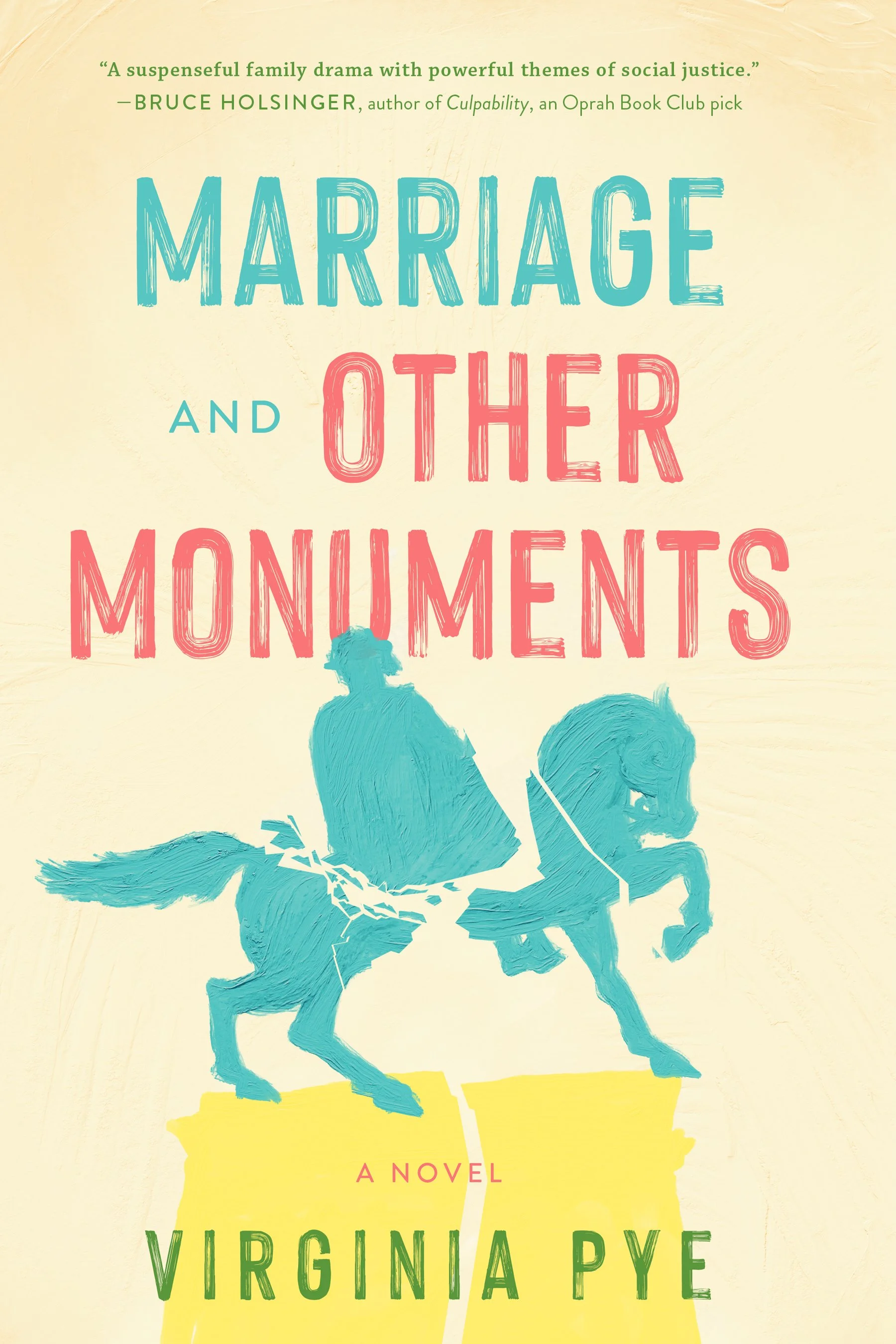
In the summer of 2020, social justice protests and the removal of Confederate monuments rock the city of Richmond, Virginia, as the marriages of two estranged sisters implode. When Cynthia’s husband, Bobby, can no longer hide his dire financial situation, their union finally ruptures. Melissa, her sister, has dedicated herself so fully to racial justice activism that she becomes alienated from her own Black husband. As the summer heats up and their marriages veer in opposite directions, the sisters have no choice but to turn to one another. Meanwhile, their husbands conspire in a racial reckoning that their ancestors—one old Virginia White, the other old Virginia Black—would never have dreamed of. When secrets within marriage erode trust, all couples must decide what’s more important: being true to who they are as individuals or holding on to an illusion of the past.
RICHMOND MAGAZINE
Love and Other Complications
Virginia Pye’s latest novel revisits Richmond during 2020.
By Harry Kollatz Jr.
Author Virginia Pye may now reside in Cambridge, Massachusetts, but her long-term home was Richmond, and it serves as the setting for her latest novel, Marriage and Other Monuments. Taking place during a tumultuous 2020—a reality many readers lived through—it involves breakups and reunions, fractures and fissures, in families and the culture.
Pye will be presenting the book in two places: first, at the Institute for Contemporary Art at Virginia Commonwealth University on Wednesday, February 18, at 5 pm for Author RVA, moderated by the ICA’s Director of Community Media Chioke l’Anson, with a reception following, at 6 pm. The event is free, but registration is required. The second presentation, an Author Discussion With Virginia Pye, will be held on Thursday, February 19, at 11 am at The Cultural Arts Center at Glen Allen, including a talk led by author Jon Sealy. Tickets are $15 for the event only and $35 with a copy of the novel.
-
Pye’s previous award-winning books (Dreams of the Red Phoenix and River of Dust) took place at crucial turning points in China, and The Literary Undoing of Victoria Swann concerned the life of a popular late 19th-century novelist in Boston. The short stories of her anthology The Shelf Life of Happiness concerned realizations, scenes from marriages and relationships breaking up, and the confrontation of death. The landscape is not dissimilar in Marriage and Other Monuments; however, the backdrop is Covid-19 and upheaval following the death of George Floyd and the repercussions for the statues on Monument Avenue.
“I think as a novelist and not an historian,” Pye reflects. “My starting place was about marriage and changes over time that can happen in a married relationship. And then, when there’s change happening all around in the broader society, how does that affect personal change and effect personal growth?”
How people can start seeing themselves in a different light as events whirl around them is shown in the book in parallel, between the lives of sisters and their husbands. Marshall Stone is a Black entrepreneur who has rehabilitated the Metropole, an art deco entertainment venue in the novel’s Jackson Ward, and his white spouse, Melissa, is somewhat recklessly committed to the larger issues of social change. Melissa’s sister, Cynthia, comes across as a class-conscious “influencer,” married to Bobby Powers, ostensible scion of a businessman father; Bobby doesn’t want to inherit the kingdom, but he’s not sure what course to take. Into this mix comes Tyisha Mayfield, a former classmate of Marshall’s who is a combination of New Age mysticism and hard-nosed commercial practicality, and Ralph, a friend of Bobby’s who runs The Shack on the James River, a gathering place of many decades for river enthusiasts and where newcomers first get their paddles wet. The location is threatened by a potential project of Bobby’s father, Preston. Amid this is the tangled old mess of the Powers family colliding with a new emerging culture.
Pye describes, “There’s a definite element of generational change, and not knowing what exactly the change is, or which direction the changes will go.”
Through Pye’s own family lineage, she possesses a personal view of how a cultural landscape can shift. Though raised in the North, she’s also the great-great-great-great-grand-niece of Georgia politician Robert Toombs. “By my generation, Toombs was a persona non grata in our family,” Pye says. “I remember my grandmother cringing at the mention of his name.”
Pye wrote an online essay about Toombs’ service in the US House of Representatives and the Senate. Though a slave owner, for most of that time he sought compromises to maintain the Union. He ultimately turned into an ardent proponent of states’ rights and joined the Confederate government as its first secretary of state. Rather than put up with Confederate President Jefferson Davis, he resigned to command troops in battle. When he didn’t receive a promotion, Toombs went home—and he barely escaped capture by Union forces.
“He fled the country unrepentant,” Pye relates. “Instead, he became more emboldened than ever. He traveled the globe espousing his white nationalist beliefs.” When Toombs returned, he remained active in Georgia society and politics and vigorously worked to block the civil liberties of Blacks. “He wasn’t ever held accountable,” Pye emphasizes. Toombs’ views remained within the national culture.
During 2020, Pye was locked down in Cambridge, watching late-night videos of events in Richmond and concerned for friends, family and the city itself. She observes, “I’ve been gone from Richmond for a decade, and I miss it; this is, in my way, a love letter. I tried to capture what makes the place special, and also what’s maddening about it. I tried to capture the charms. I was getting nostalgic about the trumpet vines in the alleys right next to a dumpster. Thing is, when you’re there you can take for granted the better qualities.”
Toward the end of Marriage and Other Monuments, the activist Melissa is on her way to another horizon, and she considers, “For if the summer of 2020 had any lessons to impart, it was that Richmond deserved a second look. Like so many smaller cities…it needed change only love could bring about.”
That is a new chapter being written.
The Richmonder
Novel Set Amid 2020 Protests Is Author’s ‘Love Letter’ to Richmond
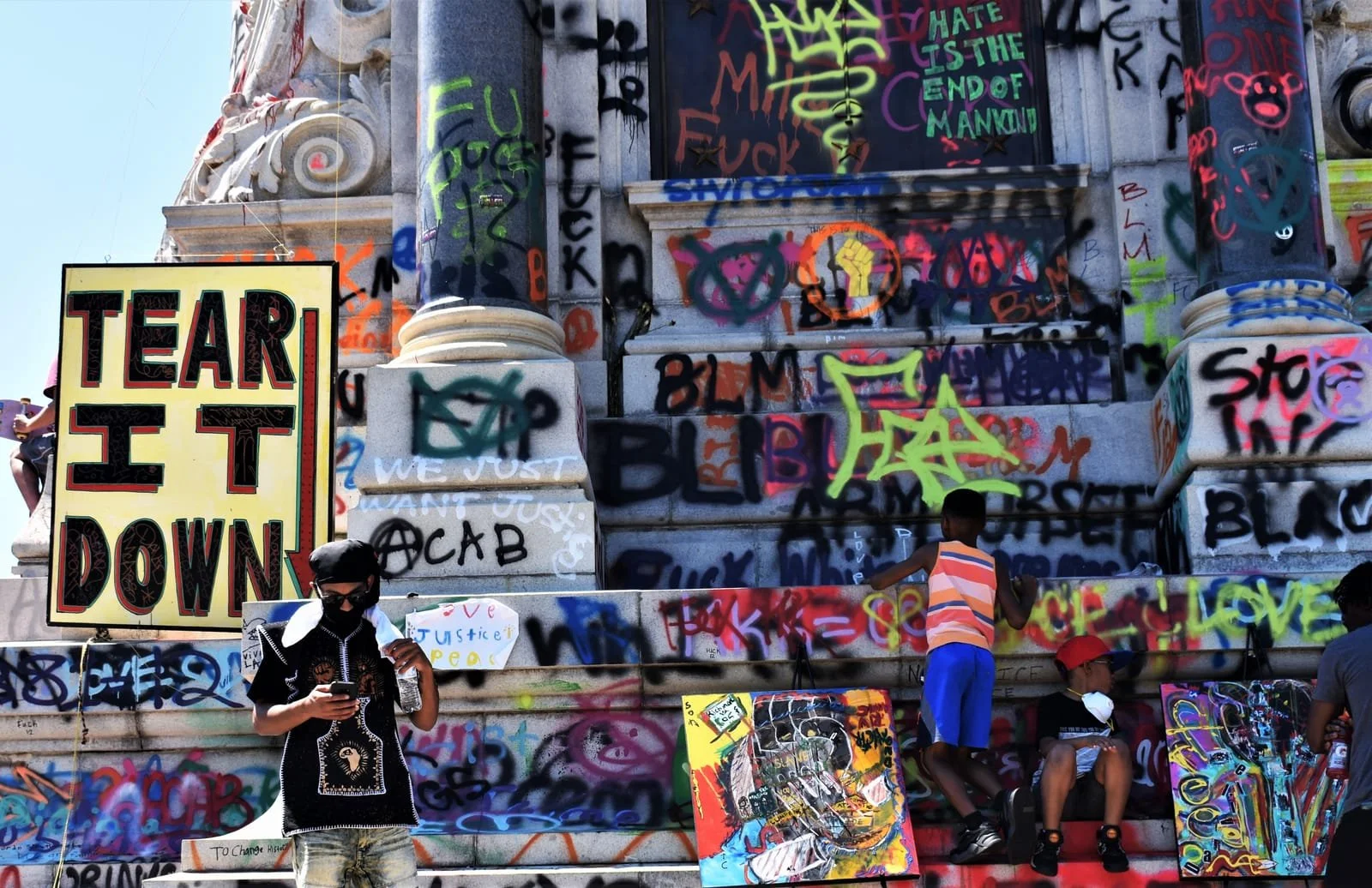
Protestors at the base of the Lee Monument in 2020. (PHOTO: Tim Wenzell)
Six years ago, the death of George Floyd triggered a wave of protests nationally. But Richmond, and Monument Avenue in particular, became a major hub of activity, ultimately leading to the removal of monuments to Confederate generals.
The history of this place and time in Richmond is the setting of Virginia Pye’s fourth novel, Marriage and Other Monuments.
The novelist lived with her husband and raised their two children in Richmond before leaving about 10 years ago.
In the summer of 2020 she watched from her home in Cambridge, Massachusetts, as the events played out night after night.
“My long-distance interest prompted my imagination, resulting in this novel,” Pye said. “I was staying up late at night watching the handheld videos by people on the streets as things were happening.”
-
She added that her son lived on Monument Avenue, heightening her concern.
Blending personal family drama with the larger political public forces taking place across the city, Marriage and Other Monuments is at once a family-driven drama and a testament to setting, where the events of 2020 Richmond exposed what was buried beneath the surface about race and class.
Besides a family drama, Marriage and Other Monuments is also a historical novel defining a crucial moment in Richmond history, all through the lens of the early days of COVID, where, as Pye notes in the novel, “catching the virus from a box of crackers seemed far-fetched, but people were dying, and no one really knew how the disease spread.”
The novel traverses the city’s neighborhoods, including The Fan, Jackson Ward, Oregon Hill, Windsor Farms, Ginter Park, and the West End, among others, returning again and again to the beauty of the James River, with its canoeing and wildlife—the permanence of the river and the natural world serving as the backdrop of a city in the throes of change.
“I added a lot of details that feel to me to be very ‘Richmond,’ and the James River is number one on that list,” Virginia said, “a navigable, beautiful, exciting river right in the middle of downtown.” She also noted that she used the James as a metaphor for history and time and the river “carrying on.”
The novel’s strength is in its setting—not just Richmond, but that hectic summer of 2020.
“It makes for a very good place to write about because of the contradictions that exist in Richmond, and during that period in the summer of 2020, those contradictions bubbled to the surface.”
This “bubbling to the surface” culminated in the removal of the Confederate monuments. As Pye writes in the novel, “for years Richmond had dithered and done nothing about Monument Avenue, where the grand statues cast their ugly shadows.”
The novel’s title reference to “Other Monuments,” outside of the Confederate statues, offer “monuments” as symbols that also were in need of dismantling: the institution of marriage in the lives of two estranged sisters, as well as racial, economic, familial, and societal monuments being torn down as well. As Pye writes, “the grand statues situated along almost a mile of the handsome boulevard were too divisive, and in fact, downright reprehensible to let them stay.”
Finally, the base of the Lee monument, the last of the statues to go, served as a metaphor for all of the other “monuments” in the lives of Pye’s characters.
“The entire base of the statue had been transformed over the past weeks into an impressive work of protest art. Robert E. Lee was no longer the reason people stopped and stared as they drove by. With so much happening below, the historic man above had grown obsolete. It was time for him to ride off into the sunset.”
Pye notes of Richmond, “As the years passed and we put down deeper roots, we came to understand Richmond more fully as a wonderful place, with unique qualities and people.”
And as she writes at the end of the book: “For if the summer of 2020 had any lessons to impart, it was that Richmond deserved a second look.”
Pye’s book launch begins Wednesday at the Institute for Contemporary Art from 5-6 pm, with a reception after. The event will feature a conversation with Chioke I’Anson. She will also be appearing at the Glen Allen Cultural Arts Center with novelist Jon Sealy on Thursday. The book is available for sale with a list price of $24.
—Tim Wenzell
Style Weekly
Summer of Reckoning
Former Richmonder Virginia Pye’s new novel, Marriage and Other Monuments, takes place in the volatile summer of 2020.
Author Virginia Pye’s new book, her fifth, looks at how secrets within a marriage erode trust, and how for couples to evolve, they must be true to who they are, both as individuals and as members of an imperfect society.
What sets Marriage and Other Monuments apart from other relationship novels is that it takes place in Richmond during the summer of 2020. For those of us who lived through that transformational season of unrest, it’s a compelling reminder of just how central the city was during a time of national reckoning. The book was published on February 10, and Pye will speak at the ICA and the Cultural Arts Center at Glen Allen the following week.
Pye, a Richmond resident for 17 years, moved to the Boston area in 2015, where she remained during lockdown. During the early 2000s, she’d written a novel attempting to capture the charm and beauty of Richmond, as well as how its class differences and historic trauma affected her characters.
-
“Although that book was never published, I had it in mind as I followed the events in Richmond in the summer of 2020,” Pye says of watching live videos of street encounters between protestors and the police. “I wanted to tell a story that respected the city while also delving into marriage at a time of great social change and upheaval.”
For locals, the book reads like a refresher course in the non-stop civil unrest that defined that summer as the monuments finally began to come down. Pye fills the story with references that resonate: locations such as Oregon Hill, Ginter Park, Belle Isle and the Fan, but also specific businesses like Franco’s and Sally Bell’s Kitchen.
When she refers to “families like his who had lived in the West End for generations,” longtime Richmond residents understand exactly who she’s referencing. Only a stickler for accuracy would wince at seeing Libbie Avenue being spelled Libby.
Having been married for almost 40 years. Pye tried to use that knowledge to shape the two marriages in her novel. What seems most crucial for the four main characters—Melissa and Marshall, Cynthia and Bobby—is to be honest not just with their spouses, but with themselves. “They’re pushed by the events of that dramatic summer to realize ways they’ve been lying to themselves about what they want and who they are,” she says. “They can’t share honestly with their spouse if they’re hiding from their own truth.”
Sisters Melissa and Cynthia aren’t close and don’t particularly want to be. Pye intentionally began the story with the two already on shaky ground, allowing the reader to wonder from the start if they’ll achieve balance again.
Because each chapter is written from the perspective of one of the four characters, the reader comes to know the sisters separately for most of the book, seeing how they frame their growing up experiences differently. Each feels the other doesn’t fully understand the sacrifices she made and both want more from the other and are bitter not to receive it. “In short, they’re siblings, with all the resentment and, ultimately, love that involves,” says Pye. “Because they do love each other. They just want the other to say it first.”
Pye is quick to say that she was incredibly lucky to have raised her family in Richmond and that it’s a wonderful place to live for many. But she also sees it as a complicated, maddening and beautiful place given the James River and the charming, quirky neighborhoods, each with its own character.
The maddening part, she feels, isn’t unique to Richmond. Rather, it’s the ongoing fallout of America’s original sin, slavery. But unlike many other parts of the country, for decades, Richmond residents didn’t have the luxury of ignoring that history, especially when the monuments were still up. “The drama of their removal brought to the surface that painful past,” Pye says. “My novel tries to write respectfully about characters who lived through that summer, as well as conjuring figures from the historic past.”
That historic past is all over Marriages and Monuments, from references to redlined neighborhoods to the glory days of the Deuce, aka Second Street. Central to the story is the evolution of Monument Avenue, perhaps best expressed by Melissa’s husband, Marshall (who is Black). “And these old monuments and this avenue have never been the heart of Richmond. Jackson Ward deserves that honor.”
To which this reader says, amen.
—Karen Newton
Richmond Times Dispatch
The Literary Undoing of Victoria Swann
By Virginia Pye
Regal House Publishing | 2023
In Seneca Falls, New York, in 1848, the first Women’s Rights Convention began the slow process that led to profound but still unfinished progress.
The title character, a brave young woman, lends her voice to the struggle in The Literary Undoing of Victoria Swann, Virginia Pye’s third novel.
Set in Boston at the cusp of the 19th century to the 20th, it chronicles the early success of a novelist who produces romance and adventure tales but who struggles after transitioning to realism.
As the story opens, Victoria tells her editor, elderly Frederick Gaustad, that she wishes to shift her work from formulaic mediocrities to stories that reflect substance and authenticity. Frederick objects and directs her to a new sub-editor, Harvard graduate Jonathan Cartwright, who figures in a touching subplot.
-
Meanwhile, the publishing house is purchased by former dockworker Louis Russell, who has little interest in books but covets money and runs a disreputable side establishment.
Raised on a remote farm, orphaned Victoria fell in love and wed Raymond Byrne, but the marriage succumbs to her ne’er-do-well husband’s drinking and gambling.
And when Louis demands that she stick with the profits her former genre earns so that she can pay Raymond’s gambling debts, she refuses and goes her own way.
Sympathetic Jonathan supports her decision to adopt a new brand.
“From now on, I intend to write about real people with real and regular lives,” she tells him. To which he replies, “We all have regular lives, Victoria, but when we see them reflected back to us in stories, they become more than that.”
What follows exacts multiple costs as she stands her ground.
Pye, a former Richmonder who now lives in Cambridge, Massachusetts, is also the author of two previous historical novels, 2013’s “River of Dust” and 2015’s “Dreams of the Red Phoenix,” and a short-story collection, 2018’s “Shelf Life of Happiness.
Known for her affecting storylines and depth of characterization, she fills this novel with those winning attributes as she simultaneously adopts Boston-centric sensibilities of the era, with a plot that’s formal but never stuffy, characters who are appealing but never exaggerated and prose that’s elegant but never pretentious.
A rewarding exploration of transformation that despite tribulations leads to triumphs, Pye’s latest validates the life-affirming blessings of courage.
—Jay Strafford
SMALL Press PICKS
The Literary Undoing of Victoria Swann
By Virginia Pye
Regal House Publishing | 2023
Although it’s set in the Gilded Age, this witty and engaging novel explores issues that continue to be deeply relevant, while offering an entertaining and inspiring read. (The novel can be preordered now, and its launch is planned for October 3.)
As the novel opens, its protagonist, Victoria Swann, is an established writer of more than a dozen romance and adventure novels set in exotic locations. Bearing titles such as Damsel of the Deep Sea and Fair Lady of Forgotten Shores, the books are highly popular with young women and, consequently, a success for Victoria’s genteel Boston publisher, Thames, Royall & Quincy.
By all appearances, Victoria seems successful as well. She’s wealthy and always stylishly dressed, and she and her husband share a comfortable home on fashionable Brattle Street in Cambridge.
-
But when Thames, Royall is acquired, things take a troubling turn for Victoria. The new management intends to sign even more lurid fare, starting with a book by a prominent dancehall singer. Victoria, though the financial powerhouse of the firm, is treated as slightly better than a nuisance. Also, the timing of the change in management is unfortunate for her because she is hoping to publish a novel, The Boston Harbor Girl, that is quite a departure from her previous ones. With it, Victoria is taking a new, more realistic direction, one that reflects the struggles of women who share none of the privileges that she’s come to know.
(The Boston Harbor Girl might be seen as coming from the literary movement known as naturalism, which originated in the late nineteenth century. Naturalism is characterized by a kind of objective and detached viewpoint, and often features lower-class characters subject to forces beyond their control. One notable work from this movement is Stephen Crane’s 1893 novella Maggie, A Girl of the Streets, a story of poverty and despair.)
The shift in Victoria’s subject matter comes from far more than a desire to chart a fresh literary course. Not wanting to give away too much, I’ll just say that The Boston Harbor Girl is far more meaningful to her, personally, than her previous novels, making the stakes of getting it out into the world that much higher.
Unfortunately, the new direction of Victoria’s work does not go over well with her editor, or with her husband, an alcoholic spendthrift. Both of them have a financial interest in her continuing to turn out sensational–and highly profitable–novels. (Eventually, her husband’s greed turns out to be financially devastating for Victoria.)
In another disturbing turn, Victoria realizes that she is underpaid compared to male authors at Thames, Royall; she receives a much lower royalty rate than they do. Even more pressing, with the changes in the ownership of the publisher, she no longer receives any royalty payments at all.
Victoria realizes that this injustice cannot go unchallenged, and one of the great pleasures of the novel is seeing her push back against it while holding onto her dream of publishing fiction that, although far less remunerative, could make a lasting impression on readers. (In writing about Victoria’s confrontation with her publisher, Pye took as inspiration the case of a Boston writer, Mary Abigail Dodge, who in 1867 sued her publisher, Ticknor and Fields, for royalty payments that were deliberately less than those of male authors.)
Unfortunately, the story of the inequities Victoria faces remains more than relevant today. To give just one example, the gender pay gap in the United States has changed little over the past 20 years. On a happier note, what also remains relevant is the power of writers engaging with issues that are deeply meaningful to them–and telling stories they believe must be told, even if there is little to gain and, perhaps, much to lose. As a culture, where would we be without such stories, and storytellers?
In perhaps a nod to the 1885 William Dean Howells novel The Rise of Silas Lapham, whose eponymous protagonist endures a financial decline in tandem with his moral growth, Victoria’s “literary undoing” seems to refer not to a negative development, but rather to her gain of artistic freedom and literary merit. It was a pleasure to follow Victoria on this inspiring journey. I was rooting for her at every turn.